

Why More Australian Business Owners Are Considering Restructuring Over Liquidation in 2026

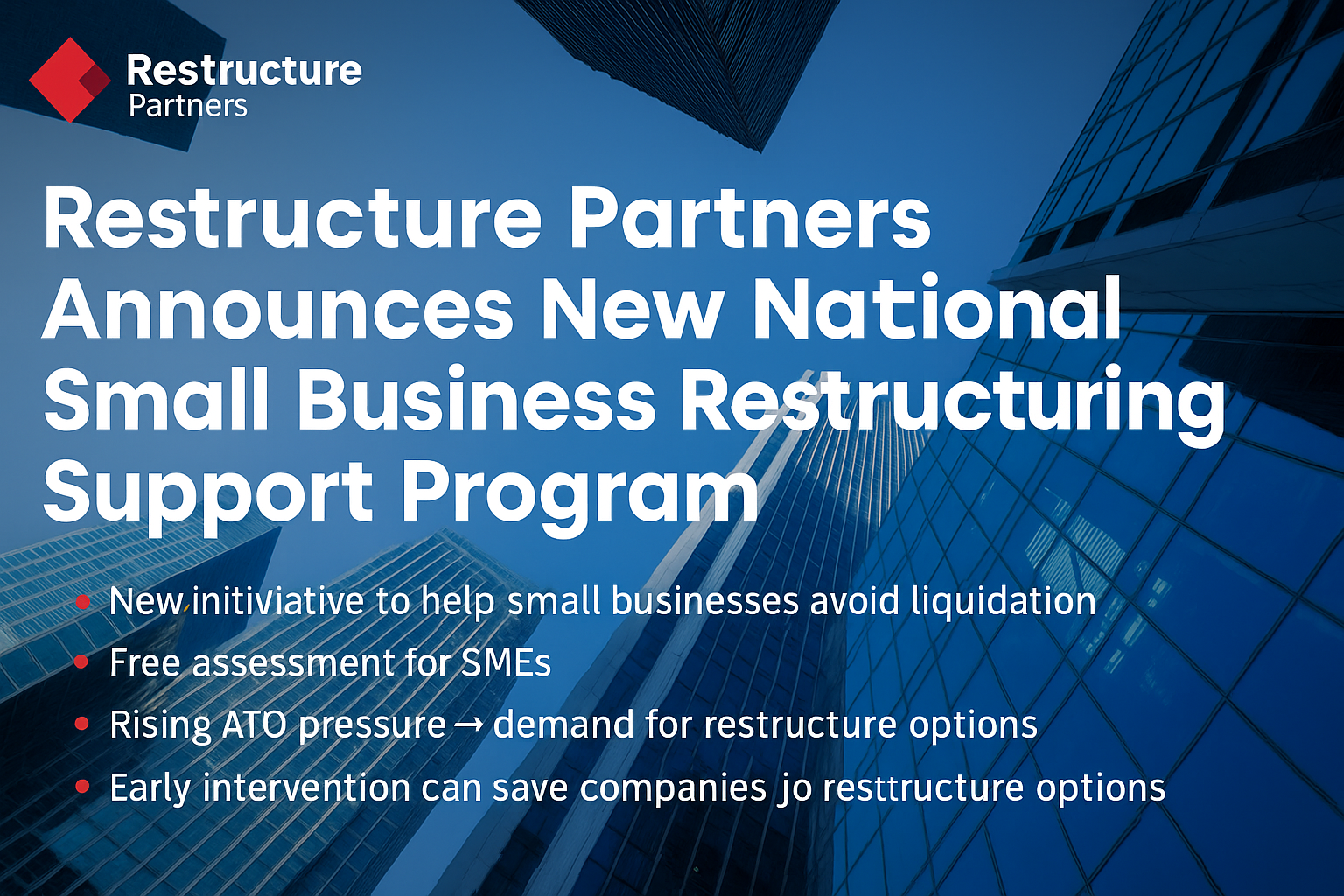
Restructure Partners
Something meaningful is shifting in how Australian directors respond when their businesses hit financial trouble.
Something meaningful is shifting in how Australian directors respond when their businesses hit financial trouble. Where liquidation was once the reflexive endpoint for a company.”
SYDNEY, NSW, AUSTRALIA, April 9, 2026 /EINPresswire.com/ -- Something meaningful is shifting in how Australian directors respond when their businesses hit financial trouble. Where liquidation was once the reflexive endpoint for a company that could no longer meet its obligations, a growing number of directors are now pausing before that conclusion — and finding that formal restructuring offers a more constructive path forward.— Restructure Partners
ReStructure Partners helps Australian directors navigate every stage of ATO and financial distress, from overdue BAS and tax debt through to Director Penalty Notices, restructuring solutions, voluntary administration, and broader insolvency options. The firm attributes this shift to greater director awareness, improved access to professional advice, and a clearer understanding of what the small business restructuring regime can deliver for eligible businesses.
What Has Changed
Several developments have contributed to this trend. The most significant is the maturation of the small business restructuring regime itself. Introduced in January 2021, the regime has now established a track record. Directors who might previously have assumed that formal insolvency equated to liquidation now understand that restructuring is a distinct and often preferable option.
The role of the ATO as a major creditor has also influenced the shift. The ATO has publicly indicated that it will vote in favour of restructuring plans where the proposed creditor return exceeds what would be achieved in a liquidation. This position has given many directors confidence that a well-structured plan has a realistic prospect of acceptance, depending on the circumstances.
The third factor is simply the economic environment. Many businesses experiencing difficulty in 2026 have sound underlying operations. Their problem is not that their model has failed, but that historical debts — accumulated during the pandemic or through the cost pressures of the post-pandemic period — have become unmanageable. For these businesses, liquidation would destroy value that could otherwise be preserved.
ReStructure Partners assists directors in understanding whether small business restructuring or voluntary administration may be viable options given the specific facts of their situation. Further information is available at https://restructurepartners.com.au/small-business-restructuring.
The Practical Advantages of Restructuring
From a practical standpoint, restructuring through the small business restructuring regime offers several potential advantages over liquidation for eligible businesses.
The director retains control of the company throughout the process. Operational continuity is maintained, staff relationships are preserved, and customers are not alerted to a management change. The process is designed to be completed within a defined timeframe — 20 business days for plan development — which limits the period of disruption.
The cost of a small business restructuring is generally lower than a full voluntary administration, making it more accessible for businesses with limited resources. And the outcome — a creditor-approved plan allowing the company to continue trading with a manageable repayment schedule — can represent a genuine fresh start for a business that has been weighed down by historical obligations.
Voluntary administration, while more complex and expensive, also offers restructuring possibilities through the deed of company arrangement mechanism. For businesses not eligible for small business restructuring, or where the complexity of the situation warrants a more comprehensive process, voluntary administration can provide a pathway to continued operation.
Details on the voluntary administration process are available at https://restructurepartners.com.au/voluntary-administration.
A Considered Choice, Not a Default
The trend toward restructuring does not mean liquidation is the wrong choice in every case. There are circumstances — where the business model is broken, where debts vastly exceed assets, or where the directors need to draw a definitive line — in which liquidation is the most appropriate outcome.
The point is that this choice should be made with full information about the alternatives, not by default. Directors who understand the full spectrum of options available in 2026 are consistently better positioned to achieve outcomes that serve their interests and those of their creditors.
ReStructure Partners works with Australian directors and business owners experiencing financial pressure, including ATO debt, cash flow issues, and creditor stress. The firm provides support across the full spectrum of financial distress, from early-stage tax arrears and compliance issues through to Director Penalty Notices, small business restructuring, voluntary administration, and other insolvency pathways, depending on the circumstances.
Contact:
ReStructure Partners
https://restructurepartners.com.au
###
Restructure Partners
Restructure Partners
+61 468 061 936
email us here
Legal Disclaimer:
EIN Presswire provides this news content "as is" without warranty of any kind. We do not accept any responsibility or liability for the accuracy, content, images, videos, licenses, completeness, legality, or reliability of the information contained in this article. If you have any complaints or copyright issues related to this article, kindly contact the author above.
